
Quality Standard
The Quality Standard grades your whole governance system, stage by stage.
One standard for the whole of school governance. It runs on the SGAF framework and maps your board across three progressive stages, from a compliant foundation to governance that survives any change of people.
Free to self-assess. Independently verifiable when your board is ready.
Or start the free self-assessment and see where your board stands.
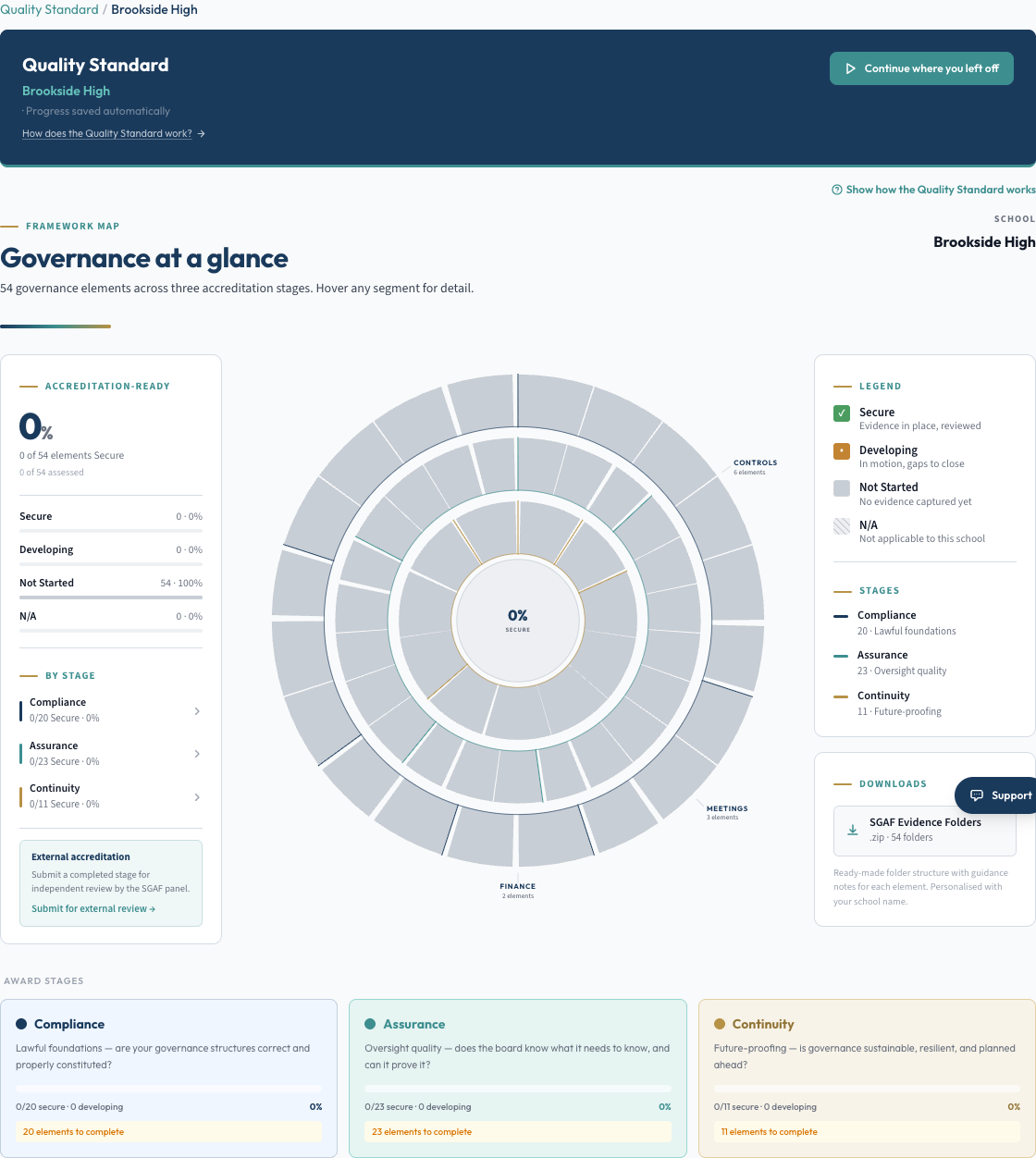
Graded across three progressive stages of governance maturity
Built on the DfE governance guidance and the standards schools are held to
Free to self-assess, independently verifiable when you choose
Designed by a governance practitioner, not a software company
The problem
Every part of school improvement has a system. Governance never had one.
Boards are asked to show impact, not just activity, yet most have no structure to produce that evidence. Governance rests on a few key people who each carry it in their heads, so when one of them leaves, quality is at risk.
Healthcare has the CQC. Finance has the FCA. Manufacturing has ISO. School governance now has a standard of its own.
The three stages
A progressive model of governance maturity
Every board sits somewhere on this map, and each stage builds on the one before. The Quality Standard shows you exactly where you stand and what to prioritise next.
Stage one · Compliance
Compliance
The legally sound foundation.
“Is the board properly constituted, meeting its statutory duties and running its core business reliably?”
The foundation everything else rests on: clerking, delegation, statutory duties, financial oversight and a live policy schedule. Without it, nothing else holds.
Explore ComplianceStage two · Assurance
Assurance
The everyday running of effective oversight.
“How does the board know the school is improving in the right areas, at the right pace, for the right pupils?”
Where compliance asks whether the board does the right things, assurance asks how it knows they are working. It connects governor monitoring to real evidence of impact.
Explore AssuranceStage three · Continuity
Continuity
Governance that survives a change of people.
“Will governance stay effective through a change of chair, head or clerk?”
The highest level of maturity. Most boards run well until a key person leaves. Continuity is what keeps governance strong when that happens, so the system survives turnover.
Explore ContinuityFrom self-assessment to verified standard
Self-assess for free. Verify when you are ready.
The Quality Standard is open from day one. Work through every stage at your own pace and see where your board stands. When a stage is solid, an independent practitioner can verify it, so your position is proven rather than self-declared.
Step one · Self-assess
Grade your board against every stage
Free and open to any governing board. Assess yourself across Compliance, Assurance and Continuity, see your whole position at once, and know what to strengthen next. Every element you secure is captured as evidence.
Step two · External Validation
Have a stage verified by an independent practitioner
When a stage is solid, book External Validation. A practitioner reviews your evidence through a meeting, not a form, at £295 per stage. Your board earns a verified position it can display and share.
For every role
What the Quality Standard gives each seat at the table
The same standard, read through the job you actually do.
Chair
The whole board's position on one map, and a shared plan the board owns rather than one person carrying it.
Headteacher
A clear answer to “how do you know?”, backed by evidence the board has already gathered across the year.
Clerk
A structure to work to, so every meeting and every record builds toward the same recognised standard.
Governor
A clear picture of what good governance looks like, and exactly where you can help move it forward.
Overseeing several schools? The same standard rolls up across the trust. See governance for trusts →
Common questions
How the Quality Standard works
The practical detail for governing boards and trust central teams.
Is the Quality Standard free?
Yes. Self-assessment is open to any governing board at no cost. You work through every stage at your own pace and see where you stand. Independent External Validation is a separate paid step, for when you want your position verified.
Do we have to complete the stages in order?
For self-assessment, no. Every stage is open from the start, so you can see your whole position at once. External Validation is taken one stage at a time, in order, because each stage builds on the one before.
How is this different from a one-off governance review?
A review is a snapshot on one day. The Quality Standard is a standard your board works to across the year, so the evidence stays current and you can show how your governance has matured over time.
What is External Validation?
An independent practitioner verifies a stage of your Quality Standard through a meeting, not a form. It is £295 per stage and gives your board a verified position it can share with parents, the diocese, an academy trust or an inspector. See External Validation for how it works.
Does it work for a single school and for a trust?
Both. A single board works to the standard on its own, and across an academy trust each school's position rolls up into one shared view for the central team. See governance for trusts.
Get started
One twenty-minute call. No commitment.
See the whole system with your own school's data in front of you, then decide.