
Meeting Agendas
Every meeting ends with a verifiable artefact.
Nine meeting templates, from the full governing board to the subcommittees that often run without a professional clerk in the room, each mapped to the framework with statutory items flagged and the right term already prompted. Download as Word or copy straight into your existing papers, then mark the meeting held as a separate, deliberate step.
Included in SGAF membership, from £229 per school per year.
Nine meeting types, from the full governing board to the Annual Safeguarding Review
Framework reference on every substantive item, statutory ones flagged
Marking a meeting held kept separate from generating its agenda
Download as Word or copy straight into your existing papers
How it works
Three steps, then the cycle holds itself to it
Every meeting type carries its own standing items, its statutory flags and its own place in the governance year.
Choose a meeting type
Nine templates, each with standing items already in place and the statutory ones flagged, so a committee that meets without a professional clerk still gets the same structure as the full board.
Add the term's focus
Autumn, spring and summer each carry their own section, so the statutory item due this term is already on the agenda, not remembered at the last minute.
Run it, then mark it held
Download the agenda as Word or copy items into your existing papers. Marking the meeting held is a separate, deliberate step from preparing its agenda, so a downloaded document is never mistaken for evidence a meeting happened.
The nine meeting types
- Full Governing Board
- Resources / Finance Committee
- Curriculum / Standards Committee
- Pay Committee
- Headteacher Performance Management
- Complaints Panel
- Exclusions / Pupil Discipline Panel
- Annual Safeguarding Review
- Skills Audit & Training Review
Where it sits in the loop
Decisions become owned action
Every meeting is where the board's actions are actually taken, before the year's work becomes the annual statement.
Audit
Guided checks and the termly website review surface what needs attention.
Risk
Findings become risks, each with an owner and a review date.
Action (this tool)
Decisions are taken in the room, then filed as a record.
Statement
The year's evidence becomes the board's annual account.
Oversight
Every school's position rolls up into one live view.
Real UI
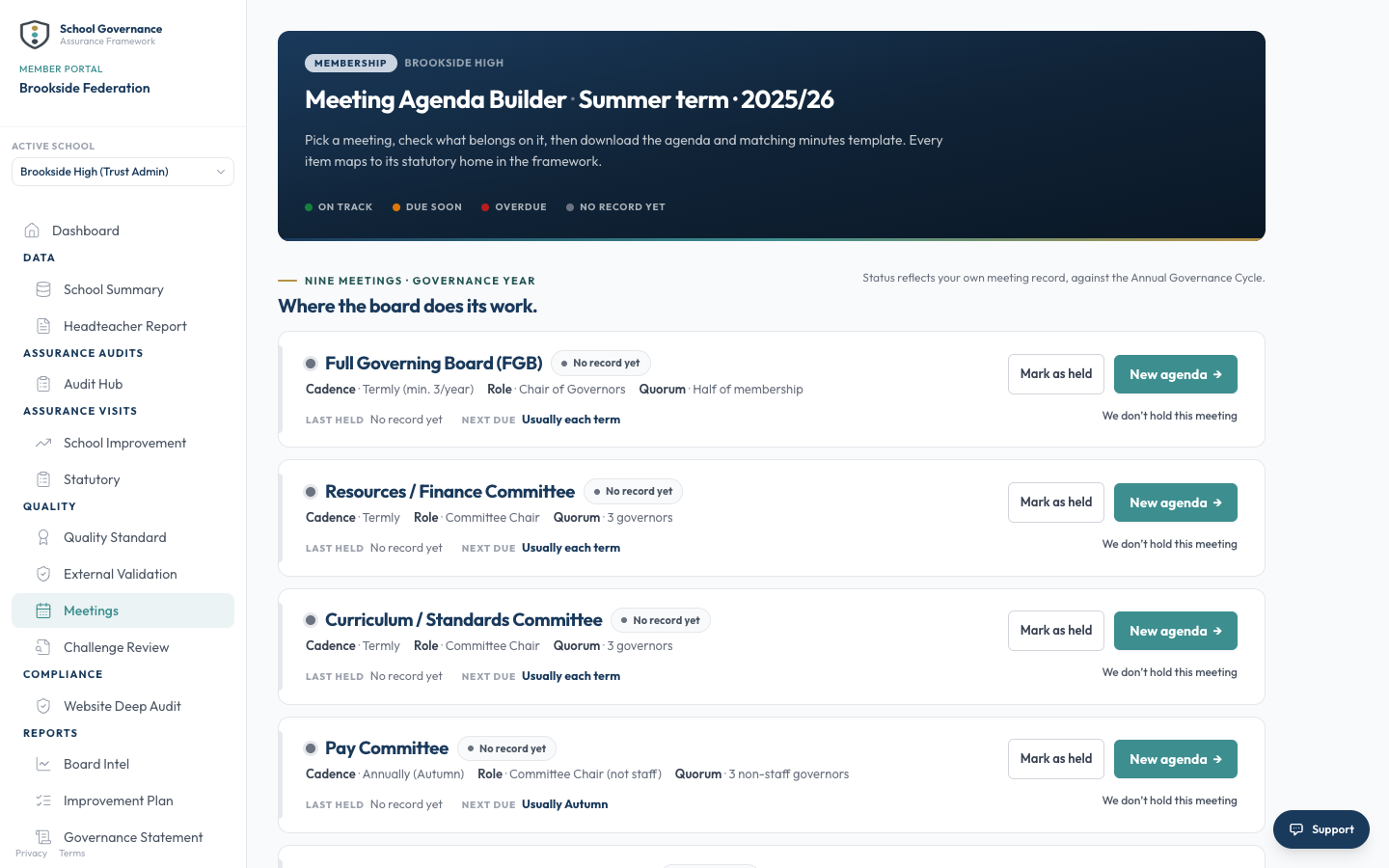
Every meeting knows where it stands
This is one school's actual meeting cycle, not a demo built for the site.
- Cadence, chairing role and quorum shown against every meeting type
- Last held and next due, so a slipping cycle is visible before it becomes a problem
- Mark as held, start a new agenda or say a meeting is not held at your school
- A status of on track, due soon, overdue or no record yet, for every meeting
For every seat
What structured agendas give each seat at the table
The same nine templates, useful in a different way depending on your role.
Chair
Every statutory meeting on cycle
The full statutory meeting cycle sits in one place, so nothing is running on memory or waiting for someone to notice it is overdue.
Headteacher
Subcommittees get the same structure
Finance, curriculum and the panels that meet less often carry the same framework mapping as the full board, not whichever agenda a governor remembers from last time.
Clerk
An agenda built from a template, not from scratch
Start from a template that already carries the framework reference and the statutory flags, add or remove items to match how your board actually works, then download.
Governor
The same clarity in every committee
Turn up to a subcommittee with the same structure and challenge prompts as the full governing board, even when there is no professional clerk in the room.
Overseeing several schools? See meeting cadence across the estate, not school by school. See governance for trusts →
Common questions
How Meeting Agendas works
The practical detail before you book a walkthrough.
Does this cover subcommittees or just the full governing board?
All nine meeting types, including the committees that most often run without a professional clerk in the room: Resources/Finance, Curriculum/Standards, Pay, Headteacher Performance Management, Complaints, Exclusions, the Annual Safeguarding Review and Skills Audit & Training Review.
What happens when we mark a meeting as held?
It is kept as a separate, deliberate step from generating the agenda, so preparing the papers and certifying that the meeting actually took place stay as two distinct acts. That is what keeps the held-meeting record honest.
Do the statutory items change by term?
Yes. Autumn, spring and summer each carry their own section on the Full Governing Board agenda, so the right statutory item, such as the Scheme of Delegation review or the SFVS deadline, is prompted at the right point in the year.
Can we still use our own meeting papers?
Yes. Download the agenda as a Word document or copy items straight into the papers you already use. A minutes template is available the same way.
Is this included in membership or a separate cost?
Included in SGAF membership at both price points, with no add-on cost.
Not ready to talk? See where your board stands first.
Run a free check →Get started
One twenty-minute call. No commitment.
See the nine templates mapped to your own framework and governance year.