
Risk Register
Every risk to the school, in one register the board acts on
SGAF is the Governance Operating System for UK schools and academy trusts. The Risk Register is built around ten categories from the Orange Book and DfE guidance. Score each risk by RAG or a likelihood and impact matrix, record a treatment, an owner and a review date and watch the risks that matter most surface for the board on their own. Across an academy trust, every school's register rolls up into one view for the centre.
Included in every SGAF membership, from £229 per school per year.
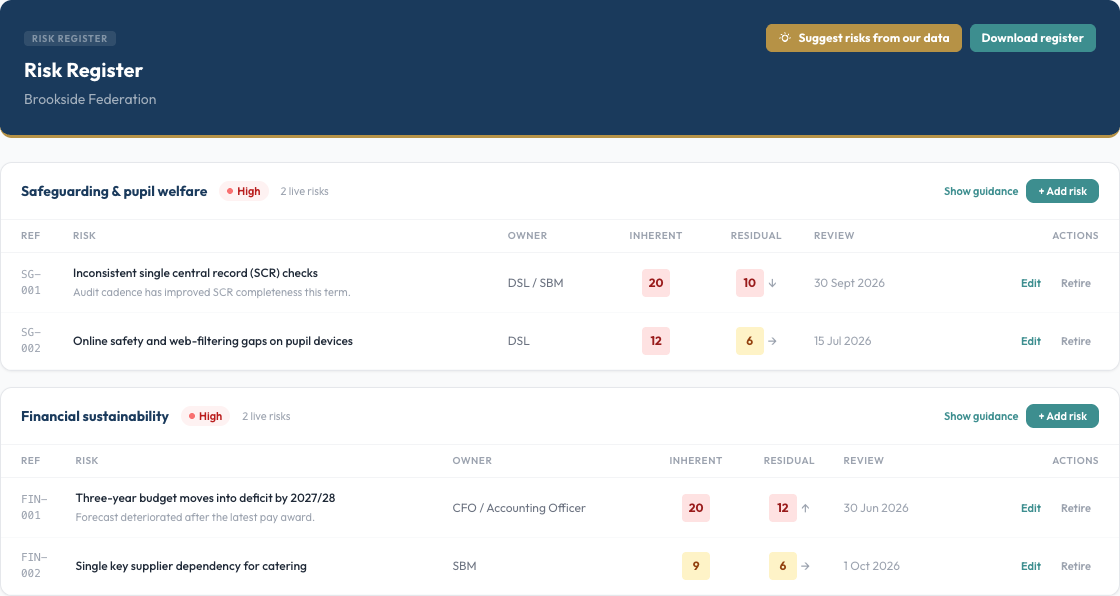
Ten categories, drawn from the Orange Book and DfE guidance
Every risk with an owner, a response and a review date
RAG for a single school, a likelihood and impact matrix for a trust
School registers roll up into one trust-wide view
How it works
Ten categories, scored your way, owned by name
Every risk a governing board carries has a home from the start, a score that fits how your board works and a person accountable for it.
Ten categories, already mapped
Safeguarding, finance, pupil numbers, estates, people, standards, governance, cyber, reputation and continuity. Every risk has a home, modelled on the Orange Book and DfE guidance for schools.
Score it the way your board works
A simple RAG status suits most single schools. A likelihood and impact matrix suits a trust comparing schools, with the amber and red thresholds set centrally.
A treatment, an owner and a review date
Every risk records the board's chosen response, who owns it and when it is due back, so the risks that matter most surface for the board on their own.
Nothing is added without a person deciding. Signals from tools like the Headteacher Report and the website check can suggest a candidate risk, but the board stays in control of what its register says.
Where it sits in the loop
Where the Risk Register sits in the loop
A finding from any check can be weighed as a risk here. Once recorded, it becomes an owned action, feeds the annual statement and rolls up for the trust.
Audit
Guided checks and the termly website review surface what needs attention.
Risk (this tool)
Every finding the board accepts lands here with an owner and a review date.
Action
Risks become visit plans and actions the board can track.
Statement
The year's risk position feeds the board's annual account.
Oversight
Every school's register rolls up into one live view.
Across a multi-academy trust
School registers, one trust-wide view
For an academy trust, the register is most powerful at the centre. Each school's register rolls up into a single view, so the central board sees where the estate needs attention without chasing separate spreadsheets.
- Consistent scoring, set centrally by the trust
- Principal risks gathered from every school in one place
- A board paper the central board can table without rework
Illustrative view. School names and statuses are examples. See the Trust Command Centre →
For every seat
What the Risk Register gives each seat at the table
The same register, whatever your role at the board.
Chair
See the risks that matter, not a spreadsheet no one revisits
- Principal risks surface without hunting for them
- A clear RAG position to open every meeting with
- The board's chosen treatment recorded against each entry, not just a score
Headteacher
Point to what is already being done
- Mitigations already logged against each risk
- A dated position ready whenever a risk is queried
- The same register the board actually looks at, not a parallel copy
Clerk
Minutes and the register tell the same story
- Review dates that match what is minuted
- Nothing to reconcile between the meeting and the file
- One register, not three versions living in different folders
Governor
A plain status to challenge at every meeting
- Green, amber or red for every risk in your remit
- The owner named, so you know who to ask
- A direction of travel, rising, falling or static, not just a snapshot
Common questions
How the Risk Register works
The practical detail for boards and trust central teams.
Does the register write itself from our other data?
No. Signals from tools like the Headteacher Report and the website check can suggest a candidate risk, but nothing is added to the register without a person deciding. The board stays in control of what its register says.
RAG or a matrix, how do we choose?
Most single schools prefer the simple RAG status, fast to keep current and easy for every governor to read. A trust comparing several schools usually wants the likelihood and impact matrix, with amber and red thresholds it sets itself. You are not locked into one or the other.
What happens when a risk is closed?
It stays on the register as a closed record with its history intact, rather than disappearing, so the board can show how a risk was identified, treated and resolved over time.
Can we export the register for a meeting?
Yes. A single school can export its full register for the file, and a trust can export a board paper leading with the principal risks across the estate, ready to table without rework.
What does it cost?
The Risk Register is included in every SGAF membership, with no separate fee. Membership is £229 per year for a primary and £329 for a secondary, per school, with the same per-school price across an academy trust and no volume discount.
Comparing this with a spreadsheet register?
Plenty of boards keep a shared spreadsheet, and it works while someone keeps it current. See what changes once each risk carries an owner, a treatment and a review date the system holds rather than one person. A spreadsheet register, or the Risk Register →
Not ready to talk? See where your board stands first.
Run a free check →Get started
One twenty-minute call. No commitment.
See your own school's risks in the register, then decide.