
Governance Statement
By the time it's due, the material already exists.
SGAF is the Governance Operating System for UK schools and academy trusts. Its Governance Statement tool gathers the year's evidence, your Quality Standard progress, your live risks and your tracked actions, into the board's annual account. The board adds its own honest reflection on top, then records its adoption. From that moment the statement locks as the record, ready to download and publish.
Included in every SGAF membership, from £229 per school per year.
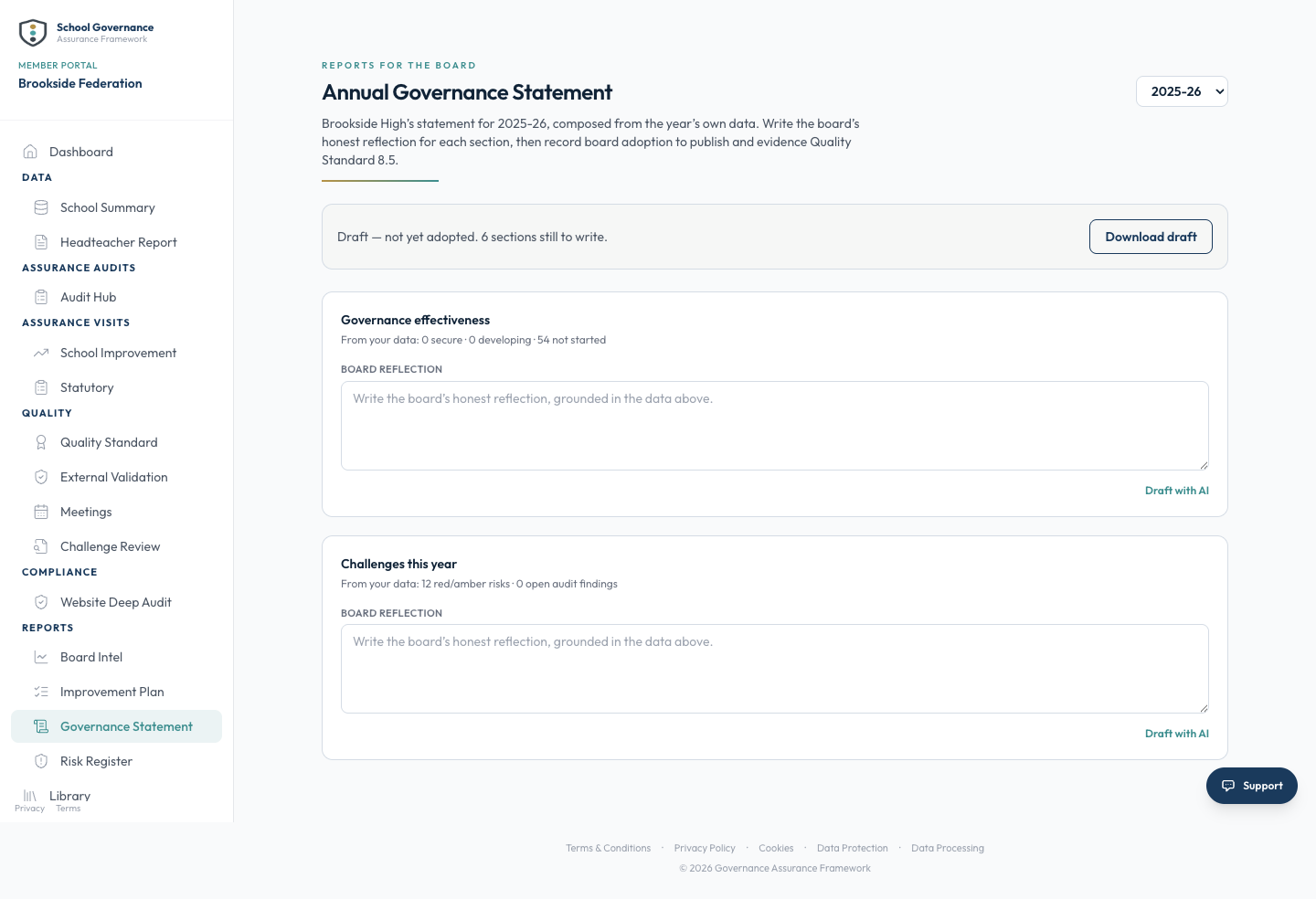
One statement per school, per academic year, composed from your own evidence
Effectiveness, challenges and priorities drawn from your Quality Standard, risks and actions
Locked only when the board records its adoption, with a minute reference
The adopted version never changes quietly: an amendment always opens a fresh draft
How it works
The board writes the account. Not the facts.
The statement separates the two jobs: assembling this year's record and judging it. The system does the first so the board can concentrate on the second.
The facts are already there
Governance effectiveness, this year's challenges and next year's priorities are drawn from the Quality Standard, your live risks and your tracked actions the moment the statement opens.
The board writes the account
The board adds its own honest reflection to each section, in its own words. Training and attendance have no tracker to draw on, so the board writes those two from scratch as well.
Adoption locks the record
Recording the board's adoption, with a minute reference, freezes that exact version as the adopted statement, ready to download and publish. An explicit amendment is the only way back in.
Nothing here starts from a blank page. A year of governing has already produced the facts; the board's judgement is what turns that into an account of it.
Where it sits in the loop
Part of one connected system
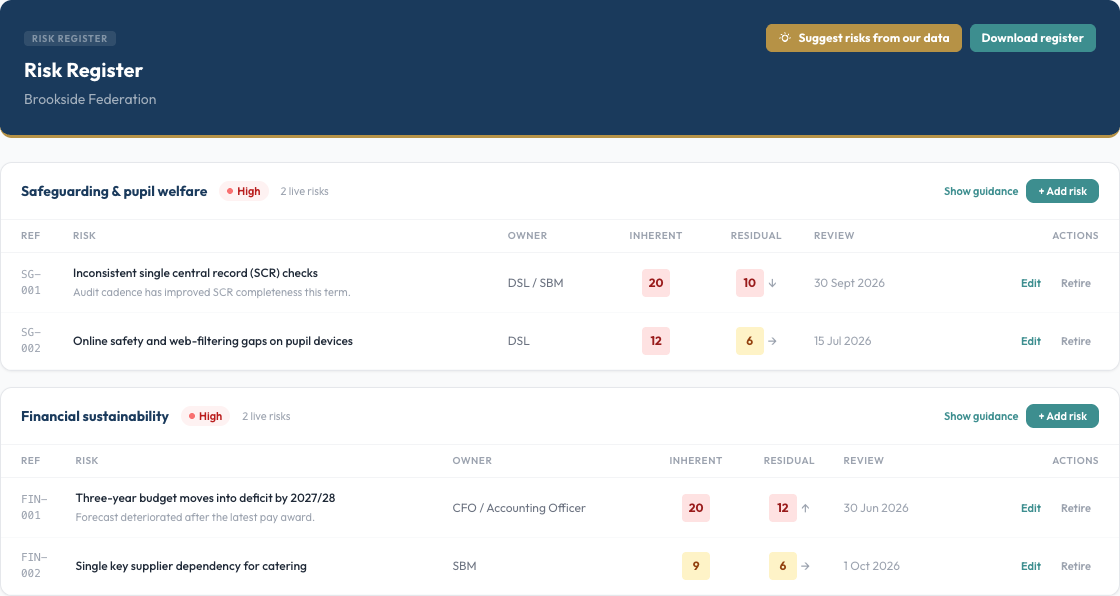
Audit findings become risks. Risks become actions. Actions become the annual statement. Trusts see all of it live.
Audit
Guided checks and the termly website review surface what needs attention.
Risk
Findings become risks, each with an owner and a review date.
Action
Risks become visit plans and actions the board can track.
Statement (this tool)
The year's evidence becomes the board's own account, in these words.
Oversight
Trusts see every school's position, live.
Where the evidence comes from
Every section already has its facts
The board never opens an empty section. Each factual half draws on work already logged elsewhere in the system.
Governance effectiveness reads the school's own Quality Standard posture. Challenges this year draws in the live red and amber risks and the audit findings not yet secure. Priorities for next year pulls from the open actions on the improvement plan and the school's own priorities. Only training and attendance are left for the board to write by hand, because the portal holds no tracker for either.
For every seat
Built for the people who sign off the year
The same account, whatever your role at the table.
Chair
Sign an account the board can stand behind
- Every section already carries this year's evidence before the board writes a word
- Nothing is published until the board records its adoption
- A minute reference ties the statement to the meeting that approved it
Headteacher
Show the difference a year of governance made
- The statement draws on the same evidence as the board's termly briefing
- Priorities the board has been monitoring carry straight into the forward look
- One account, ready to share with parents and the wider community
Clerk
File the year's account without starting from scratch
- The factual sections are already there when the academic year ends
- An adoption note and minute reference keep the record tidy
- The adopted version stays fixed, however the next draft changes
Governor
See your term's work become the board's account
- The priorities you monitored this year show up in the forward look
- The challenges the board named all year are the ones it reflects on
- A published record any governor can point back to
Common questions
What boards ask about the statement
The practical detail before your board writes its first one.
Do we start from a blank page?
No. The factual sections, governance effectiveness, this year's challenges and next year's priorities, are drawn from your Quality Standard progress, your live risks and your tracked actions. The board's job is to write the honest reflection on top, not assemble the facts first.
Does our school have to publish one?
Academy trusts publish a governance statement as a required part of their audited annual accounts. Maintained schools have no statutory requirement, though an honest annual account is strong practice for any board. Either way, the tool works the same way.
Can we change the statement after the board adopts it?
Recording adoption locks that exact version, so nothing changes quietly. If the board needs to revise it, an explicit amendment reopens a fresh draft, and the version already adopted stays available throughout.
How does this relate to Board Intelligence?
They draw on the same year's evidence. Board Intelligence gathers it into a termly briefing; the Governance Statement gathers it into the board's own year-end account.
Not ready to talk? See where your board stands first.
Run a free check →Get started
One twenty-minute call. No commitment.
See how the statement composes from your own school's data, then decide.